






What have the payment giants done in the past month?


- 核心观点:AI支付与稳定币正重塑支付行业格局。
- 关键要素:
- Stripe、Google、Mastercard推出AI支付协议。
- Visa、Stripe加速稳定币基础设施布局。
- ChatGPT等AI平台成为新购物入口。
- 市场影响:推动支付行业向AI代理化转型。
- 时效性标注:中期影响


Text | Sleepy.txt
Editor | Kaori
If you haven't been paying attention to the payments industry in the last month, you might have missed some important news.
On September 29th, Stripe and OpenAI jointly announced that ChatGPT users could make purchases directly within their chat window, eliminating the need to redirect to a merchant's website. The next day, Visa launched a stablecoin pre-load pilot program, allowing financial institutions to use USDC and EURC for cross-border settlements. A day later, Stripe struck again, launching a platform called "Open Issuance," which allows any business to issue its own stablecoin.
On October 9th, news broke that Mastercard and Coinbase were bidding for the stablecoin infrastructure company BVNK, with bids ranging from $1.5 billion to $2.5 billion. Just last December, the company’s valuation was only $750 million.
This is just the tip of the iceberg. If you extend the timeline to the whole of September, you will find that Mastercard, Google, Visa, and Stripe all released their major actions in the fields of AI payment and stablecoins almost in the same time window.

Review of key news events
Let’s first take a complete look at the key events of this month.
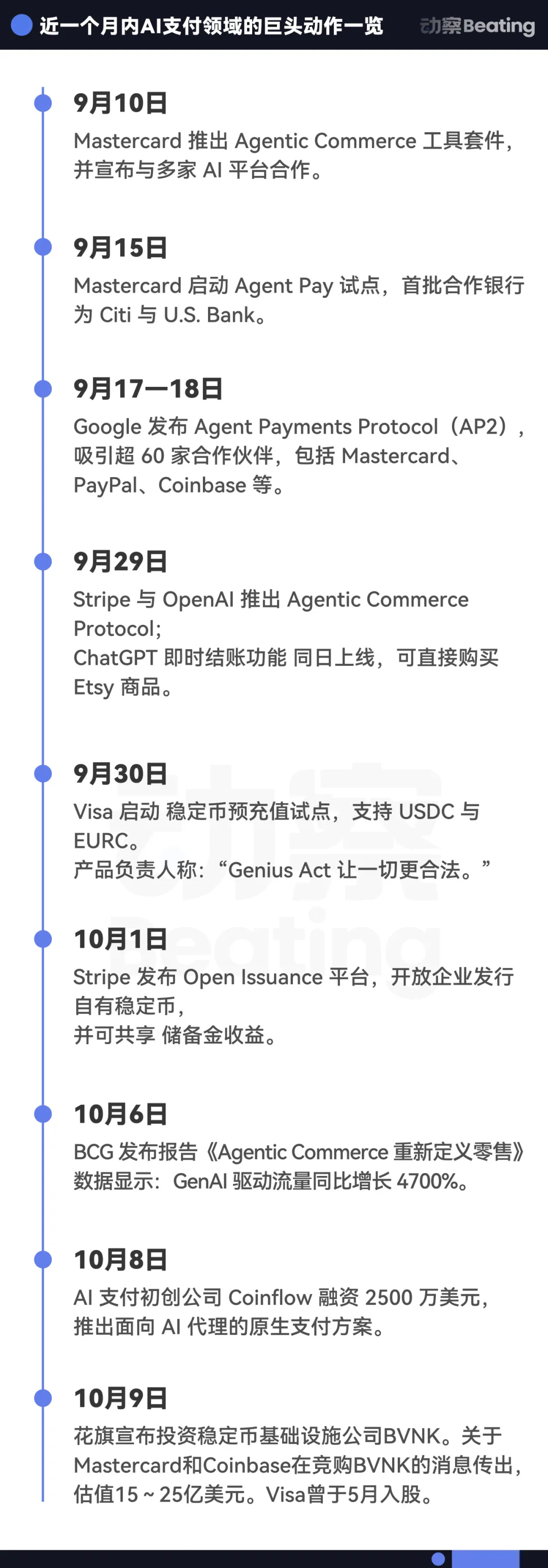
Nine major news releases in one month are rare in the payments industry. More importantly, these pieces of news aren't isolated product launches; they reinforce each other and build upon each other.

Who will legislate for AI agents?
When AI agents begin to initiate payments on behalf of humans, the really tricky problems emerge - who authorizes it, who is responsible, and how to prevent AI from completing an erroneous transaction under illusion?
Traditional payment systems are built on the simple premise that humans will click the purchase button. But when this premise is broken, the entire authorization and accountability mechanism must be redesigned.
Stripe and OpenAI's answer is Shared Payment Tokens (SPTs). This new payment primitive allows AI agents to initiate payments on behalf of users without accessing their actual account or card information. Each SPT is limited to a specific merchant and shopping cart amount, giving the AI sufficient payment permissions while protecting user privacy and security.

Stripe facilitates transactions, applies fraud detection, and enforces token controls in real time. Image source: Stripe
ChatGPT’s instant checkout feature is based on this technology, and users can already buy Etsy products directly in chat. Soon, this feature will be expanded to Shopify merchants, including Glossier, Vuori, Spanx, SKIMS, and other brands.
Google chose a different approach. It proposed the AP2 protocol, which uses three types of verifiable digital credentials: Intent Mandate, Cart Mandate, and Payment Mandate. The Intent Mandate defines the conditions under which a user authorizes an agent to make a purchase; the Cart Mandate is a cryptographically signed authorization from the user for a specific shopping cart; and the Payment Mandate signals to the payment network and issuer that the transaction is being conducted by an AI agent.
This mechanism provides fine-grained control and traceable audit trails. Google emphasizes that AP2 is an open protocol, an extension of A2A and Model Context Protocol, and does not belong to any single company.
Mastercard's strategy is more pragmatic. "Agent Pay" doesn't emphasize technological innovation; its core value lies in compatibility. Mastercard is collaborating with multiple platforms, including Stripe, Google, and Ant International's Antom, to ensure its payment network seamlessly integrates with the mainstream AI agent ecosystem.
The three protocols were launched around the same time. They attempted to solve the same problem, but took completely different approaches. Stripe chose to first dominate the market and then promote the standard; Google first established the standard and then attracted applications; and Mastercard did not seek dominance, but rather presence.
History has repeatedly proven that whoever controls the standards controls the future. This battle over protocols is quietly shaping the power landscape in the AI business era.

The battle for stablecoins
Stablecoin transaction volume has long surpassed the combined volume of Visa and Mastercard, the two largest payment giants. This figure has reawakened the industry's awareness that stablecoins are no longer merely experiments in the crypto world but are becoming the underlying infrastructure of the global financial system. This trend has been further amplified by the rise of AI-powered payment processing.
AI agents require a 24/7, instant settlement, low-cost, and programmable payment method. Traditional bank wire transfers can take days, and cross-border payments often involve multiple intermediaries. Stablecoins are a natural fit for this need, settling in seconds with minimal fees. They can also be integrated with smart contracts to execute complex payment logic.
Google's AP2 protocol explicitly uses stablecoins as its primary means of payment. In their design, stablecoins serve as a universal language among AI agents, offering both digital throughput and monetary stability.
Traditional payment giants have chosen different response strategies.
Visa has launched a stablecoin pre-load pilot program, allowing financial institutions to top up Visa Direct accounts with USDC and EURC. In other words, stablecoins are no longer competitors outside the Visa ecosystem, but rather are being absorbed into the network. In an interview with Reuters, Visa's head of product, Mark Nelsen, stated that the underlying software of the global payment system is extremely difficult to rebuild, and integrating stablecoin technology into existing processes is a more realistic approach.
Stripe's Open Issuance takes a more radical approach. This platform not only supports stablecoin payments but also allows any business to issue its own stablecoin. More importantly, businesses can share in the profits generated by the reserve.
In the past, issuers like Circle and Tether would invest user deposits of US dollars in low-risk assets like government bonds, keeping all the profits themselves. Stripe breaks this pattern by allowing issuers to share profits with businesses.
Stripe President William Gaybrick believes that the gradual clarification of regulatory frameworks has significantly lowered the barrier to entry for businesses in the stablecoin space. He predicts the emergence of dozens, if not hundreds, of enterprise stablecoins. Open Issuance supports multiple chains, including Ethereum, Solana, and Stripe's own Tempo blockchain.
The bidding war for BVNK revealed the true value of stablecoin infrastructure.
Founded in 2021, the company focuses on helping businesses achieve seamless conversions between stablecoins and fiat currencies. It has extensive banking partnerships and financial licenses in multiple locations, and has processed more than US$20 billion in transactions.
Last December, BVNK's valuation was only $750 million. Within a year, it had jumped to between $1.5 billion and $2.5 billion. Mastercard and Coinbase were vying for the company, while Visa and Citigroup had invested in it.
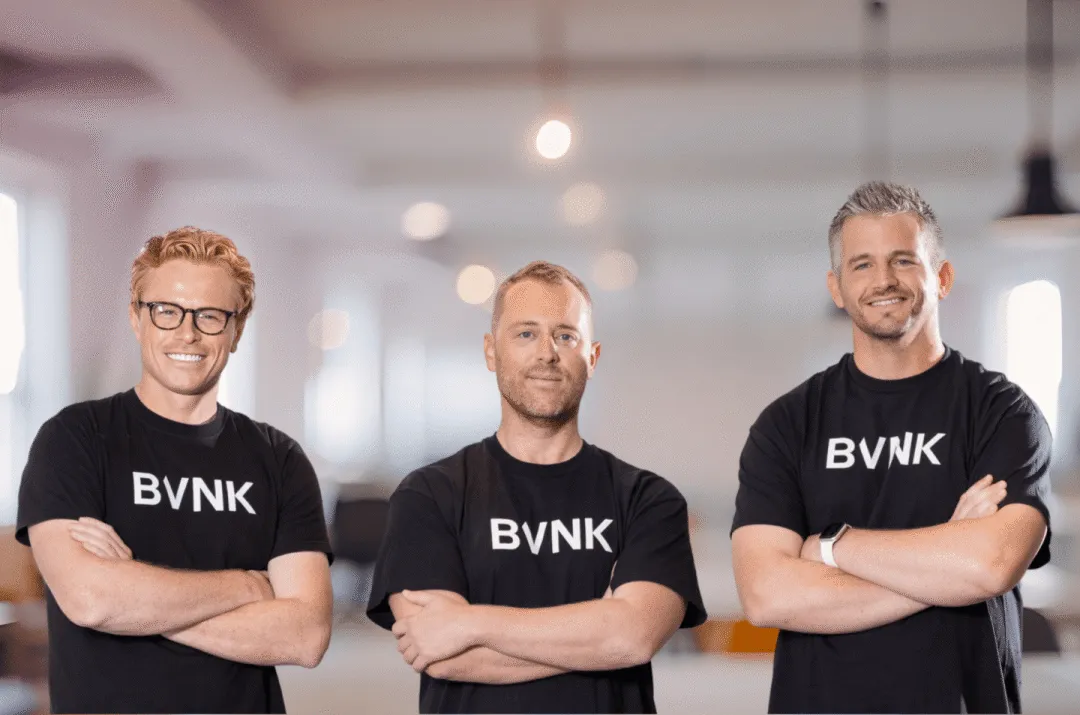
BVNK founders from left to right: Chris Harmse, Jesse Hemson-Struthers, and Donald Jackson | Source: BVNK
The significance of BVNK lies in the bridge it builds between the traditional fiat currency system and the rapidly expanding stablecoin network. In the context of AI-powered payments, the value of this bridge is redefined. Whoever controls it possesses a critical channel between the old and new financial systems.
For Mastercard, the acquisition of BVNK means it can quickly fill out its stablecoin infrastructure and avoid being marginalized in the new wave of technological advancements. For Coinbase, it presents an opportunity for strategic expansion, moving from exchanges to the broader payments sector, and building a Stripe for the crypto world.
BVNK's surge in valuation reflects the market's repricing of stablecoin infrastructure. In the era of AI-powered payments, these companies play a role similar to clearing houses in the traditional financial system. They not only handle transactions but also serve as the underlying pipeline for the flow of value.

Competition for traffic entrances
Protocols and infrastructure are armaments, but the real battlefield is at the application layer. Whoever can get users accustomed to completing purchases on AI platforms will control the future of commerce.
ChatGPT's instant checkout marks a milestone. It marks the first step in the journey of AI-powered payment processing from concept to reality. Users can purchase items on Etsy directly within a conversation with ChatGPT, without having to navigate to the merchant's website. Stripe provides the payment infrastructure, and OpenAI provides the traffic flow. The combination of the two creates a completely new shopping experience.
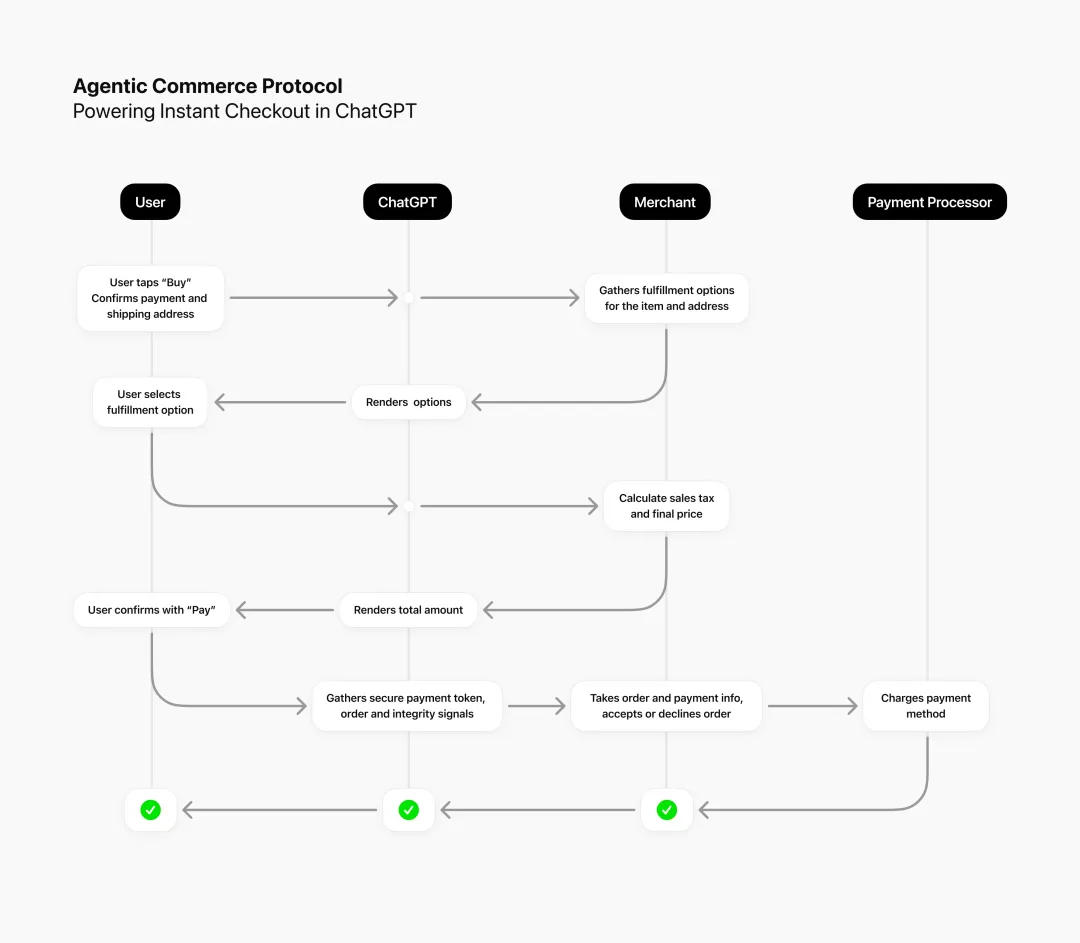
Interactions between users, ChatGPT, merchants, and payment processors | Source: ChatGPT
This feature will soon be extended to Shopify merchants, with brands like Glossier, Vuori, Spanx, and SKIMS already ready to connect. Sam Altman said this is the starting point for AI Commerce.
Google is also accelerating its efforts. It announced that it will expand its AI Mode shopping interface in the coming months, adding price tracking and direct purchase capabilities. Users can browse, compare, and order within AI Mode, with transactions ultimately completed through Google Pay.
Perplexity is also not far behind. This AI-powered search engine launched a "Buy with Pro" feature, partnering with PayPal to allow users to check out directly within the chat interface. It also integrated with Firmly.ai, a platform backend that allows merchants to easily access it.
A BCG report released on October 6th revealed key data. In July 2025, traffic to US retail websites from GenAI browsers and chat services increased by 4,700% year-over-year. These users also behave differently from traditional visitors: they spend 32% more time on site, view 10% more pages, and have a 27% lower bounce rate.
More importantly, by the time they arrive on a website, they’re often already in the latter half of their purchasing decision process. Adobe data further confirms this, with over half of consumers expecting to use AI assistants for shopping by the end of 2025.
Traffic entry points are being rewritten. In the past, people accessed e-commerce websites through search engines or direct visits; now, AI platforms are becoming the new entry point. As consumers become accustomed to completing their purchases through ChatGPT or Google AI Mode, retailers' official websites may gradually become less relevant.
The impact of this change is profound. The direct customer relationships that brands have spent decades building may now be taken over by AI platforms. Consumer behavior data and transaction records will no longer belong to retailers but will instead be integrated into AI databases.

A war about rules
Over the past month, we have witnessed payment giants launching an all-out attack on three fronts.
At the protocol level, Stripe's ACP, Google's AP2, and Mastercard's Agent Pay are all vying for a core proposition: who will set the rules for AI agents? These protocols define how AI agents initiate payments, how they are authorized, and how they are held accountable. Whoever controls these protocols controls the power of discourse in the era of AI commerce.
At the infrastructure level, Visa's stablecoin pilot, Stripe's Open Issuance, and the bidding war over BVNK are all vying to answer another question: who controls the pipelines through which value flows? Stablecoin transaction volumes have surpassed those of traditional payment networks, and they are becoming the preferred tool for AI-powered payments. Whoever owns the stablecoin infrastructure will possess the clearing and minting power of this new era.
At the application level, ChatGPT's instant checkout and Google's AI Mode are competing for the final hurdle: who will become the new traffic gateway? As users become accustomed to shopping on AI platforms, retailers' official websites and brand portals are quietly being replaced. This shift in traffic signifies a shift in commercial power.
These seemingly scattered actions actually point to the same goal: to redefine the underlying rules of business operations when AI agents become new consumers.
This is a reorganization of power, from people to agents, from brands to algorithms, from payment networks to stablecoin infrastructure. Every technological revolution brings about a redrawing of the power landscape, and AI payments are no exception.
In this war, the most important thing to pay attention to may not be who will win, but who will be excluded.
BVNK's valuation has tripled in less than a year, a clear signal that the market is repricing the entire payments ecosystem. Companies that are still waiting may find they've missed the window to enter.
What's happened over the past month isn't the beginning of change, but rather the acceleration of it. The regulatory framework has taken shape, the technology has matured, and market demand has become apparent. What remains is simply execution and competition.
A new business order is taking shape, and those companies that have not yet realized that their position has changed will pay the price in this reconstruction of the order.


